During the last few years small molecule biological assays performed at publically funded screening centers have been generating very large amounts of data. The largest effort is the NIH Molecular Libraries Program , which has the goal of developing novel chemical tools (chemical probes) to interrogate biological systems using high-throughput screening (HTS). Huge data sets generated by HTS are deposited in PubChem. Other public resources for small molecule screening data include ChemBank or the Psychoactive Drug Screening Program Ki database. In addition to data in PubChem and other public databases there are even larger data sets in pharmaceutical companies.
It is our mission to make these diverse HTS data much easier to interrogate and thus dramatically increase their value to the chemical biology, screening and cheminformatics communities. We also want to enable the rapid integration and comparison of various screening data sets across databases. This would allow researchers to compare their own data to other public data sets, for example in PubChem. A longer-term goal is to facilitate the integration of screening data with other types of life science data, such as biological pathways, disease networks, and structural biology, etc to analyze HTS in the context of specific mechanisms of action and to facilitate the transformation of data into knowledge (see figure).

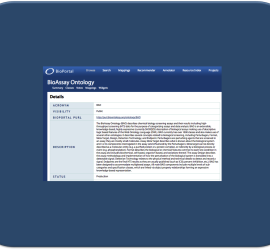
To accomplish these challenging goals we have launched the BioAssay Ontology (BAO) project, which is funded by NHGRI (1RC2HG005668‐01). In this project Stephan Schuerer, Mitsunori Ogihara, Ubbo Visser and Vance Lemmon are collaborating with others affiliated with the University of Miami Center for Computational Sciences to develop the BioAssay Ontology (BAO) to formalize the domain of biological (high-throughput) screening assays. We are also developing software tools to browse, query, and integrate diverse data sets using BAO. Our goal is to facilitate large-scale analyses of the growing body of diverse screening data sets, integration of HTS data with other life science databases, and ultimately to enable the discovery of new biomedical knowledge.
We want to involve experts in high-throughput screening, high-content screening, chemical biology, cheminformatics, data integration, and individuals with an interest in this area to build a viable community and maximize the impact of the project. Please join us on our Wiki.
How to cite BAO: Vempati UD, Przydzial MJ, Chung C, Abeyruwan S, Mir A, Sakurai K, Visser U, Lemmon VP, Schürer SC. Formalization, annotation and analysis of diverse drug and probe screening assay datasets using the BioAssay Ontology (BAO). PLoS One. 2012;7(11):e49198. doi: 10.1371/journal.pone.0049198. Epub 2012 Nov 14. |